Choosing a projector can be a daunting task, especially when confronted with a myriad of technical specifications. Among the most confusing are the different ways projector brightness is measured: ANSI Lumens and LED Lumens. These terms, while seemingly similar, represent distinct approaches to quantifying light output, leading to significant differences in what you perceive on screen. Understanding these nuances is crucial for making an informed decision and ensuring your projector delivers the visual experience you expect. This guide will demystify the world of projector brightness, helping you navigate the specifications and find the perfect light output for your needs.
Understanding Projector Brightness Fundamentals
|
Our Picks for the Best Mini projector in 2026
As an Amazon Associate I earn from qualifying purchases.
|
||
| Num | Product | Action |
|---|---|---|
| 1 | [Built-in Apps] CLOKOWE Mini Projector with WiFi and Bluetooth, 2026 Upgraded 1080P Smart Portable Projector with 180° Rotation, Auto Keystone, Compatible with iPhone/Android/Laptop/TV Stick/HDMI/USB |
![Check [Built-in Apps] CLOKOWE Mini Projector with WiFi and Bluetooth, 2026 Upgraded 1080P Smart Portable Projector with 180° Rotation, Auto Keystone, Compatible with iPhone/Android/Laptop/TV Stick/HDMI/USB on Amazon](https://reviewbcm.com/wp-content/plugins/amazon-tables/assets/images/buy.png)
|
| 2 | Mini Projector with WiFi 6 and Bluetooth 5.4 Built-in Apps for Bedroom Portable Projector Android 14 Smart Auto Keystone 1080P 4K Support Compatible with iOS/HDMI/TV Stick VisualCube 300 White |
|
| 3 | Magcubic Mini Projector with WiFi 6 and Bluetooth 5.4, Portable Projector 4K Support, 5W Soundbase Speaker, Auto Vertical Keystone 180°Rotatable Smart Proyector for Movie Home Outdoor |
|
| 4 | 【Built-in APPS & Electric Focusing & 210° Rotation】Mini Projector With Wifi And Bluetooth, 1080P Portable Projector, Movie Projector for Bedroom, Supports Smartphones/TV Stick/iPad/PS5/Laptop/HDMI/USB |
|
| 5 | HAPPRUN Native 1080P Bluetooth Mini Projector, Full HD Portable Outdoor Movie Projector with Built-in Speaker, Compatible with Smartphone, HDMI, USB, AV, Fire Stick, PS5 for Home, Bedroom, Outdoor Use |
|
| 6 | Optoma 4K UHD Projector HDR High Brightness Home Theater DLP Technology White Compact Design Gaming Ready Streaming Bundle HDMI Cable CPS 12 Month Protection Plan Included |
|
| 7 | CiBest Mini Projector, Upgraded Full HD 1080P Support Video Projector, Portable Small Movie Projector, Compatible with iOS/Android/Windows/TV Stick/Box/USB/HDMI |
|
| 8 | HP Smart Mini Projector with WiFi and Bluetooth, Short Throw Projector, Native 1080P Full HD, Official Licensed Apps, Auto Focus & Keystone, Portable Movie Projector for Bedroom & Outdoor |
|
| 9 | Mini Projector with Wifi 6 and Bluetooth5.4, Portable Projector 4K Support, Android 14 Smart Proyector with 200ASIN & Auto Keystone, Alwtniet HY300Pro Small Proyector for Bedroom, Movie, Outdoor |
|
| 10 | Mini Projector, ELEPHAS Portable Projector for iPhone, 7000L with Synchronize Smartphone Screen, Movie Projector with 1080P HD/200 Screen Support, Compatible with Android/iOS/TV Stick/HDMI/USB/SD |
|
At its core, a “lumen” is a standard unit used to measure the total amount of visible light emitted by a light source. The higher the lumen count, the brighter the light. While this fundamental definition applies across various lighting devices, including light bulbs and projectors, the specific methodologies for measuring and reporting brightness in projectors have evolved, leading to the specialized terms we often encounter.
What are ANSI Lumens?
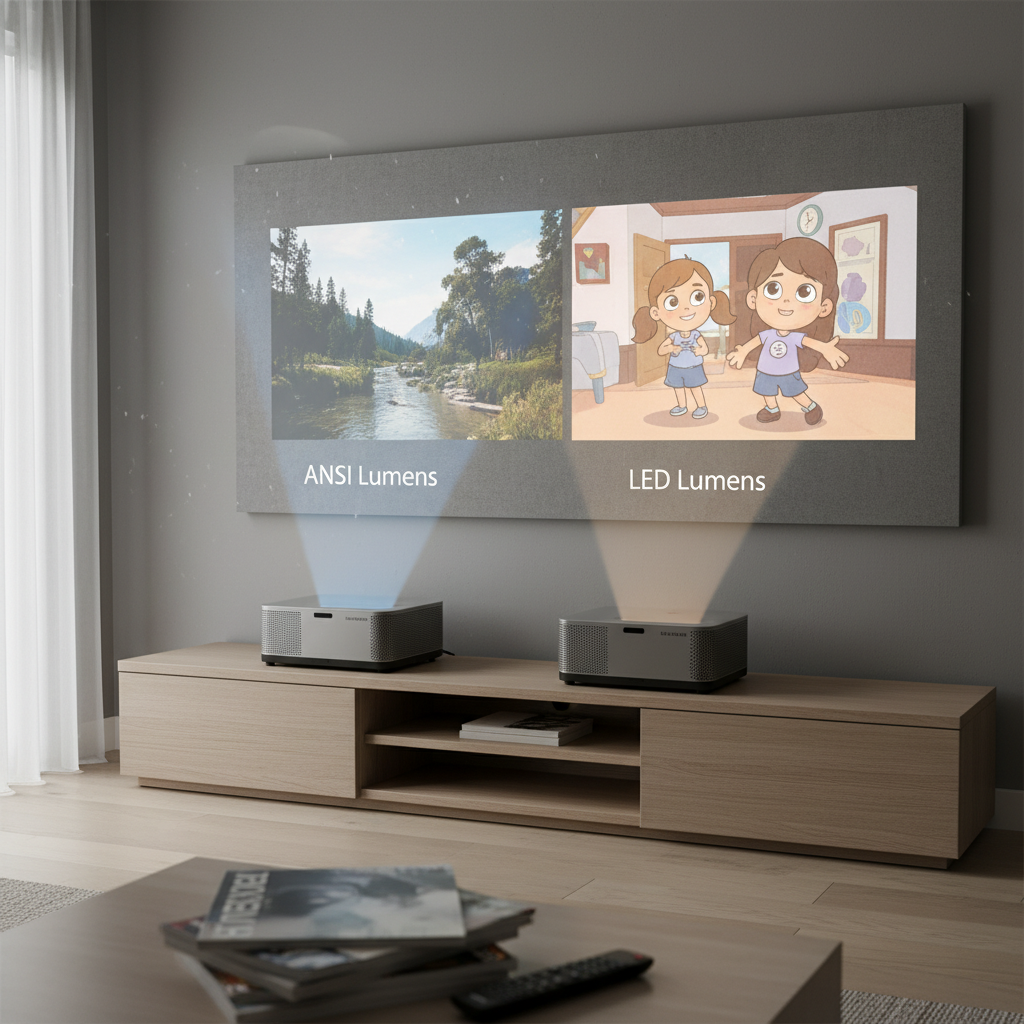
ANSI Lumens, short for American National Standards Institute Lumens, represent the industry-standardized measurement for projector brightness. This method ensures consistent and reliable comparisons across different projector brands and models. The measurement process is meticulous: the projector displays a full white image, and the brightness is measured at nine specific points across the projection screen. These nine readings are then averaged to determine the final ANSI Lumen rating. This standardized approach accounts for factors like color accuracy, white brightness, and uniformity, providing an objective and repeatable measure of a projector’s actual light output. When you see an ANSI Lumen rating, you can be confident that it represents a scientifically measured and verifiable level of brightness.
What are LED Lumens?
LED Lumens, unlike ANSI Lumens, are not a universally standardized measurement. This term is predominantly used by manufacturers of LED-based projectors, particularly in the mini and portable projector segments. The concept behind LED Lumens often takes into account the Helmholtz-Kohlrausch (HK) effect. This psycho-physical phenomenon dictates that the human eye perceives highly saturated colors as brighter than less saturated colors, even if their objective luminance is the same. Essentially, LED Lumens aim to reflect the perceived brightness to the human eye, rather than just the objectively measured light output. While LED projectors often boast a wider color gamut and richer, more vibrant colors, this subjective perception can lead to inflated brightness numbers that don’t directly correlate with ANSI Lumens.
ANSI Lumens vs. LED Lumens: Key Differences
The fundamental distinction between ANSI Lumens and LED Lumens lies in their basis: one is an objective, standardized measurement, while the other leans towards subjective visual perception.
- Standardization: ANSI Lumens follow a rigorous, internationally recognized standard (ISO 21118), making them a reliable benchmark for comparing different projectors. LED Lumens, however, lack such a universal standard, meaning their measurement methodologies can vary significantly between manufacturers.
- Measurement Philosophy: ANSI Lumens provide an objective quantification of white light output, measured under specific, controlled conditions. LED Lumens attempt to account for the human eye’s sensitivity to saturated colors, aiming to represent how bright the image feels rather than how much light it actually emits.
- Consistency: Due to standardization, an ANSI Lumen rating of 500 will represent a very similar brightness level regardless of the brand. An LED Lumen rating of 500, however, might appear brighter or dimmer depending on the projector’s color processing and the specific algorithms used by the manufacturer.
- Why the disparity? Many LED projectors excel at producing vivid, saturated colors. Because our eyes are more sensitive to these hues (the HK effect), a projector with a lower ANSI Lumen rating but excellent color reproduction might appear brighter than a projector with a higher ANSI Lumen rating but less vibrant colors. Manufacturers often use LED Lumens to highlight this perceived brightness advantage.
Conversion: Bridging the Gap
While direct conversion is not an exact science due to the subjective nature of LED Lumens, a commonly cited conversion factor exists to give consumers a rough estimate. Many industry sources suggest that LED Lumens are typically 2.4 times higher than their equivalent ANSI Lumens.
Conversion Formula:
- LED Lumens ÷ 2.4 = Approximate ANSI Lumens
- ANSI Lumens × 2.4 = Approximate LED Lumens
For example:
- A projector advertised as 2,400 LED Lumens would be approximately 1,000 ANSI Lumens.
- A 1,200 LED Lumen projector would equate to roughly 500 ANSI Lumens.
It’s important to treat these conversions as estimates. The actual perceived brightness can still vary based on the projector’s color accuracy, contrast, and your viewing environment. Some brands might even use slightly different conversion factors based on their internal testing and projector characteristics.
Which Brightness Rating Should You Trust?
For accurate, apples-to-apples comparisons between projectors, ANSI Lumens remain the most reliable and trustworthy standard. Because ANSI ratings adhere to a universal testing methodology, they provide a consistent metric for assessing a projector’s true light output.
However, understanding LED Lumens isn’t without value. If you’re specifically looking at LED-based projectors and prioritize vibrant color reproduction and a subjectively brighter viewing experience, the LED Lumen rating can give you an idea of the manufacturer’s claims regarding perceived brightness. Just be aware that a higher LED Lumen number doesn’t necessarily mean more actual light output compared to an ANSI Lumen rated projector. Always try to find the ANSI Lumen rating if available, or use the conversion factor as a guide.
Factors Affecting Perceived Brightness (Beyond Lumens)
While lumen ratings are essential, they are just one piece of the puzzle. Several other factors significantly influence how bright and clear your projected image appears:
- Ambient Light: The amount of external light in your viewing room is perhaps the most critical factor. Even a high-lumen projector will struggle in a brightly lit room. For optimal viewing, especially for home theater, a dark room is always recommended.
- Screen Size and Gain: A larger projection screen disperses the light over a wider area, potentially making the image appear dimmer. Screen gain refers to a screen’s reflective properties; a high-gain screen can reflect more light back to the viewer, enhancing perceived brightness.
- Projection Distance: The farther your projector is from the screen, the more the light spreads, leading to a dimmer image. Conversely, a shorter throw distance will result in a brighter image.
- Contrast Ratio: A projector’s contrast ratio—the difference between the brightest whites and darkest blacks—plays a huge role in the perceived depth and vibrancy of an image. A high contrast ratio can make an image look brighter and more dynamic, even if the lumen output isn’t exceptionally high.
- Color Accuracy and Gamut: As seen with LED Lumens, projectors with a wider color gamut and more accurate color reproduction can create a more visually engaging and seemingly brighter image due to the Helmholtz-Kohlrausch effect.
“Brightness specifications can be a minefield. Always prioritize ANSI Lumens for objective comparison, but don’t disregard the impact of a projector’s color performance on overall perceived brilliance.” – Dr. Evelyn Reed, Senior Optics Engineer
Buying Guide for Projector Brightness
When selecting a projector, consider these points to match brightness with your specific needs:
- Assess Your Usage Environment:
- Dark Room (Home Theater): For a dedicated home theater, 1,000-2,000 ANSI Lumens is often sufficient, as ambient light is controlled.
- Low Ambient Light (Living Room at Night): 2,000-3,000 ANSI Lumens offers a good balance.
- Moderate Ambient Light (Conference Room, Classroom): You’ll need 3,000 ANSI Lumens or more to compete with some ambient light.
- Bright Environments: Look for 4,000+ ANSI Lumens, though completely bright rooms are still challenging for most projectors.
- Consider Content Type: For critical viewing like movies, balanced brightness with good color and contrast is key. For presentations with text and graphics, higher white brightness (ANSI Lumens) can be more important for readability.
- Prioritize ANSI Lumens: If both ratings are available, always use the ANSI Lumen rating as your primary comparison metric.
- Read Reviews and See Demos: Real-world performance can sometimes differ from specifications. Look for reviews that discuss brightness in various conditions, and if possible, see the projector in action.
- Set a Realistic Budget: Higher lumen outputs generally come with a higher price tag. Balance your brightness needs with your budget.
Conclusion
Navigating the world of projector brightness, particularly the distinction between ANSI Lumens and LED Lumens, can seem complex. However, armed with this knowledge, you can approach your projector purchase with confidence. Remember that ANSI Lumens provide a standardized, objective measure for light output, making them the most reliable basis for direct comparison between different models. LED Lumens, while reflecting a projector’s impressive perceived brightness due to vivid color saturation and the Helmholtz-Kohlrausch effect, should be viewed with a conversion factor in mind to estimate their ANSI equivalent. By understanding these differences and considering your specific viewing environment and content, you can choose a projector that truly shines, delivering a breathtaking visual experience tailored to your demands. What will your next brilliant projection be?
Frequently Asked Questions
Is 1000 LED Lumens bright enough for a projector?
1000 LED Lumens is approximately equivalent to 417 ANSI Lumens (1000 ÷ 2.4). This level of brightness is generally suitable for viewing in a completely dark room or for highly portable applications where image size is small. For rooms with even minimal ambient light, it may appear dim.
Can I accurately convert ANSI Lumens to LED Lumens?
While a common conversion factor (multiplying ANSI Lumens by 2.4) is often used to estimate LED Lumens, it’s not an exact conversion. The perceived brightness accounted for by LED Lumens is subjective and can vary based on the projector’s color processing and specific light source characteristics, so use conversions as a general guide rather than a precise measurement.
Why do some manufacturers only list LED Lumens?
Manufacturers of LED projectors often use LED Lumens to highlight the perceived brightness advantage of their devices, especially when comparing them to traditional lamp-based projectors with similar or even higher ANSI Lumen ratings. This emphasizes the vibrant color experience that LED technology provides, which can make images feel brighter due to the Helmholtz-Kohlrausch effect.