In a world brimming with portable projectors, the Dangbei Neo carves out a distinct niche, promising a seamless streaming experience powered by a unique Linux operating system and, most notably, officially licensed Netflix. Forget the frustrating workarounds often associated with getting your favorite streaming services on a compact device; the Dangbei Neo aims to deliver big-screen entertainment with remarkable ease. This review dives deep into what makes the Neo stand out, evaluating its design, image and audio quality, smart features, and overall performance to help you decide if this mini projector is the perfect fit for your cinematic adventures.
A Closer Look at the Dangbei Neo: Design and Core Features
The Dangbei Neo sports a compact and subtly designed chassis, often described as a “boxy little thing,” making it genuinely lightweight and easy to transport. Weighing approximately 3.1 pounds (1.4 kg) and measuring around 3.9 by 7.9 by 6.2 inches, it’s certainly built for mobility. The housing is typically made of plastic, with metal speaker grilles adding a touch of sophistication. On the rear, you’ll find a range of essential ports, including HDMI 2.0, two USB 2.0 inputs, an Ethernet (LAN) port, an S/PDIF digital audio output, and the DC power input. Wireless connectivity is covered with Wi-Fi (Dual AC 2.4/5GHz) and Bluetooth 5.0.
However, a significant point to note for a projector marketing itself as “portable” is the absence of an integrated battery. The Dangbei Neo requires a constant power source, meaning you’ll need to be tethered to an outlet or a power station for operation. This design choice, while potentially allowing for a lighter build and more consistent performance, somewhat contradicts the expectation of truly untethered portability. Operation is primarily handled via the included Bluetooth remote control, which features convenient shortcut buttons for Netflix, Prime Video, and YouTube. A single power button is the only control found on the projector itself, making the remote indispensable.
What truly sets the Dangbei Neo apart from a crowded market of mini projectors is its software ecosystem. Eschewing the more common Android TV or Android OS, the Neo runs on a Linux-based operating system. This strategic choice is a game-changer, as it allows for smooth, officially licensed Netflix streaming directly on the device—a feat many Android-based projectors struggle with due to licensing restrictions. The Linux OS, which appears to be a variant of Ubuntu Touch (“Tionndadh OTA”), is generally praised for its responsiveness and snappier performance compared to many Android counterparts.
Image Quality: A Visual Feast (Under the Right Conditions)
When it comes to picture performance, the Dangbei Neo impresses, especially considering its compact size. It features native 1080p Full HD (1920×1080) resolution, achieved using a 0.33-inch DLP (Digital Light Processing) chip paired with XPR pixel shift technology. This setup ensures a sharp and clear image, capable of projecting an immersive display up to 120 inches. The projector utilizes an RGB LED light source, boasting an impressive lifespan of over 30,000 hours.
Brightness is rated at 540 ISO Lumens (equivalent to ANSI lumens). In a darkened room, the Neo truly shines, delivering a vibrant and sharp picture with even illumination across the screen. Colors appear vivid, and the overall image quality is more than adequate for casual viewing and home cinema. However, like many projectors in its class, the Dangbei Neo struggles significantly in environments with ambient light, such as a brightly lit room during the day, where the image can appear washed out. While color reproduction is generally good, some reviewers note a slight bluish tone and a lack of warmth, though basic color temperature adjustments are available. Contrast and black levels are sufficient for standard home cinema use, yet deep blacks can sometimes appear as dark gray, which is a common limitation in this projector segment.
The Dangbei Neo supports HDR10 and HLG HDR, aiming to deliver enhanced dynamic range and color. While some compatibility issues with specific sources have been reported in testing, the feature is present. Setup is made easier with automatic adjustments including autofocus, auto vertical and horizontal keystone correction (up to +/- 30°), and intelligent screen fit, which work reliably to square off and size the image. There’s also an obstacle avoidance feature designed to prevent projecting onto wall fixtures, though its effectiveness is higher with high-contrast objects. It’s worth noting that while these digital adjustments are convenient, physically positioning the projector to achieve the desired image size and shape is generally recommended to avoid potential reductions in brightness or introduction of artifacts.
Audio Performance: Immersive Sound for a Mini Projector
The audio experience on the Dangbei Neo is surprisingly robust for a mini projector. Equipped with dual 6W speakers and supporting Dolby Audio, Dolby Digital, and Dolby Digital Plus, it delivers a pleasant sound profile that often exceeds expectations for its category. The speakers are capable of producing high enough volume to fill a moderately sized family room, and dialogue clarity is generally good, with a decent presence in the midrange. While it won’t replace a dedicated surround sound system, the built-in audio is perfectly suitable for spontaneous movie nights or casual gaming sessions without the immediate need for external speakers.
For those who desire a more immersive audio experience, the Neo offers flexible connectivity options. You can connect external sound systems via the S/PDIF digital audio output or wirelessly through Bluetooth. Additionally, the projector itself can function as a Bluetooth speaker for other audio sources, adding another layer of versatility. One minor drawback, however, is that the sound quality may dip slightly in outdoor environments due to lack of enclosed acoustics.
A point of contention among reviews is the fan noise. While some users describe the Neo as running “quietly, even under load,” others found the fan to be “clearly audible,” particularly during quiet movie scenes, with operating noise measured around 37 dB at half a meter. This suggests that while it may not be excessively loud, sensitive viewers might notice the background hum, though many tend to adjust to it over time.
The Linux Experience: Smart Features and App Ecosystem
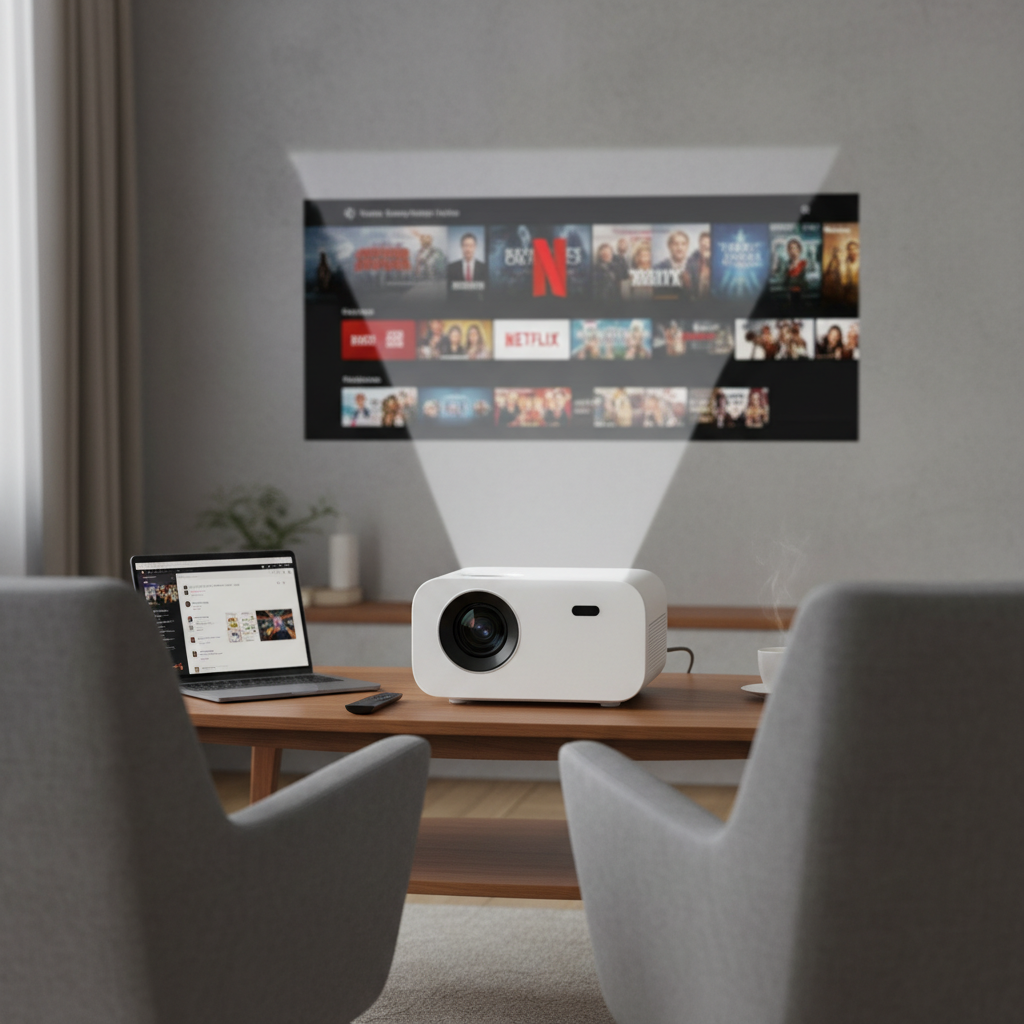
The Linux-based operating system is arguably the Dangbei Neo’s most defining characteristic. Its primary advantage is the seamless and officially licensed integration of Netflix, Prime Video, and YouTube. Unlike many Android projectors that offer unofficial or cumbersome Netflix apps, the Neo provides a smooth, reliable streaming experience directly out of the box. This is a significant convenience for dedicated streamers, removing the need for external streaming sticks for these popular platforms.
The OS is generally responsive and user-friendly, presenting a clear home screen with pre-installed apps. Beyond the major streaming services, the projector includes an app store (Netrange). However, this is where the limitations of the Linux ecosystem become apparent. The selection of apps is considerably narrower compared to Android TV, meaning you won’t find many other popular streaming services, sports apps (like MLB.TV or NFL RedZone), or other utilities readily available. For users heavily reliant on a diverse app library, this could be a drawback, potentially necessitating the connection of an external media player like a Fire Stick.
Beyond its native app capabilities, the Dangbei Neo supports streaming content via MirrorCast, HomeShare, and DLNA from Android, Windows, and iOS devices. It also recognizes classic USB data carriers, allowing you to play media content directly from a USB drive. The operating system supports basic picture adjustments through preset modes (Standard, Cinema, Sport, Vivid) and a customizable user mode. While users can adjust parameters like contrast, brightness, color temperature, and saturation, advanced color management or dynamic contrast features found in higher-end home cinema projectors are absent.
Connectivity and Usability: Getting Started and Staying Connected
The Dangbei Neo offers a solid suite of connectivity options, supporting both wired and wireless connections. For video input, there’s a single HDMI 2.0 port. Data transfer and media playback are handled by two USB 2.0 inputs. Unique for many mini projectors, the inclusion of an Ethernet (LAN) port provides a stable wired network connection, which can be preferable to Wi-Fi for consistent streaming quality. Wireless connectivity includes Wi-Fi for internet access and screen mirroring, and Bluetooth 5.0 for connecting external audio devices or using the projector as a Bluetooth speaker.
Setting up the Dangbei Neo is generally straightforward, largely thanks to its automatic adjustment features. Once powered on and pointed at a surface, the autofocus and keystone correction quickly optimize the image. The software setup process, including pairing the Bluetooth remote and connecting to Wi-Fi, is intuitive and well-explained.
However, the reliance on the remote control for virtually all functions is a notable usability point. With only a power button on the projector itself, losing or damaging the remote renders most adjustments and navigation impossible. While replacement remotes are available, it’s a factor to consider for long-term usability.
Gaming Performance: Casual Fun, Not Competitive Edge
For gamers, the Dangbei Neo offers a “playable” experience for casual gaming, but it’s not designed for competitive or fast-paced titles. Dangbei claims a low input lag of 30 milliseconds (ms). However, independent tests have measured the actual latency closer to 82-85ms for 1080p/60Hz input. While this latency is acceptable for less demanding games like party games or turn-based adventures, it’s significantly higher than what serious gamers expect and can noticeably affect reaction-time-dependent genres. The projector also lacks a dedicated “game mode” that typically reduces input lag further on other devices. Therefore, while you can enjoy gaming on a massive screen, temper your expectations for performance.
Pros and Cons of the Dangbei Neo
The Dangbei Neo is a compelling option, but like any device, it comes with its strengths and weaknesses.
Pros:
- Officially Licensed Netflix: Seamless, reliable access to Netflix, Prime Video, and YouTube directly on the device.
- Native 1080p FHD Resolution: Delivers sharp and vibrant visuals, especially in dim environments.
- Linux-Based OS: Offers a snappy and efficient user experience, avoiding common Android projector sluggishness.
- Compact & Lightweight Design: Highly portable for room-to-room or travel use.
- Automatic Setup Features: Autofocus, keystone correction, and screen fit simplify quick setup.
- Decent Built-in Audio: Dual 6W Dolby Audio speakers provide surprisingly good sound quality.
- Long LED Lamp Life: Rated for over 30,000 hours of use.
- Ethernet Port: Provides a stable wired network connection option.
Cons:
- No Onboard Battery: Requires constant power, limiting true portability despite its compact size.
- Limited App Ecosystem: Beyond the pre-installed streaming apps, the app store offers a significantly smaller selection than Android TV.
- Audible Fan Noise: Can be noticeable in quiet scenes for some users.
- Higher Measured Input Lag: Not ideal for fast-reaction gaming.
- No Controls on Projector Itself: Complete reliance on the remote control.
- Sub-optimal Daytime Performance: Image washes out in ambient light.
- Basic Picture Settings: Lacks advanced color management for demanding users.
Is the Dangbei Neo Right for You? (Buying Guide)
The Dangbei Neo is particularly well-suited for a specific type of user. If you are primarily looking for a compact, easy-to-use projector for streaming Netflix, Prime Video, and YouTube without the hassle of external devices or licensing issues, and you don’t mind plugging it in, the Neo is an excellent choice. It excels as a portable home entertainment hub for movie nights in a dark room or for taking to a friend’s house (provided a power outlet is available). Its automatic adjustments make it user-friendly, even for those new to projectors.
Consider your budget, as the Dangbei Neo is positioned in the mid-range portable projector market, typically priced around $549-$599. If a built-in battery for truly untethered outdoor use is a priority, or if you require a broader app ecosystem beyond the pre-installed services (e.g., for specific sports apps or a wider range of streaming platforms), you might need to explore alternatives, potentially at a higher price point. Similarly, if competitive gaming is a major use case, its measured input lag makes it a less ideal option. Always read recent user reviews and compare specifications with competing models like the Xgimi Halo+ or Anker Nebula Capsule 3 Laser before making a final decision.
“The Dangbei Neo strikes a compelling balance for casual streamers, prioritizing a hassle-free Netflix experience above all else in a portable form factor.” – M. David Stone, Contributing Editor, PCMag
Conclusion
The Dangbei Neo (Netflix Licensed Linux) emerges as a highly focused and capable mini projector that delivers on its core promise: straightforward, officially licensed streaming of major platforms in a portable package. Its Linux OS provides a refreshing alternative to Android, ensuring a snappy interface and reliable access to Netflix, Prime Video, and YouTube without the usual compatibility headaches. While it shines in image quality under dark conditions and offers surprisingly good audio, its lack of an integrated battery and a somewhat limited app store beyond its core offerings are noteworthy trade-offs.
Ultimately, the Dangbei Neo is an attractive option for those seeking an uncomplicated, mobile projector primarily for cinematic streaming. It’s an intelligent choice for casual users who value ease of use and guaranteed Netflix access over extensive app libraries or hardcore gaming performance. Could the Dangbei Neo be your next go-to for big-screen entertainment?
Frequently Asked Questions
What is the advantage of the Dangbei Neo having a Netflix-licensed Linux OS?
|
Our Picks for the Best Mini projector in 2026
As an Amazon Associate I earn from qualifying purchases.
|
||
| Num | Product | Action |
|---|---|---|
| 1 | HP Smart Mini Projector with WiFi and Bluetooth, Short Throw Projector, Native 1080P Full HD, Official Licensed Apps, Auto Focus & Keystone, Portable Movie Projector for Bedroom & Outdoor |

|
| 2 | Mini Projector with WiFi 6 and Bluetooth 5.4 Built-in Apps for Bedroom Portable Projector Android 14 Smart Auto Keystone 1080P 4K Support Compatible with iOS/HDMI/TV Stick VisualCube 300 White |
|
| 3 | Optoma 4K UHD Projector HDR High Brightness Home Theater DLP Technology White Compact Design Gaming Ready Streaming Bundle HDMI Cable CPS 12 Month Protection Plan Included |
|
| 4 | CiBest Mini Projector, Upgraded Full HD 1080P Support Video Projector, Portable Small Movie Projector, Compatible with iOS/Android/Windows/TV Stick/Box/USB/HDMI |
|
| 5 | Mini Projector, ELEPHAS Portable Projector for iPhone, 7000L with Synchronize Smartphone Screen, Movie Projector with 1080P HD/200 Screen Support, Compatible with Android/iOS/TV Stick/HDMI/USB/SD |
|
| 6 | HAPPRUN Native 1080P Bluetooth Mini Projector, Full HD Portable Outdoor Movie Projector with Built-in Speaker, Compatible with Smartphone, HDMI, USB, AV, Fire Stick, PS5 for Home, Bedroom, Outdoor Use |
|
| 7 | [Built-in Apps] CLOKOWE Mini Projector with WiFi and Bluetooth, 2026 Upgraded 1080P Smart Portable Projector with 180° Rotation, Auto Keystone, Compatible with iPhone/Android/Laptop/TV Stick/HDMI/USB |
|
| 8 | Magcubic Mini Projector with WiFi 6 and Bluetooth 5.4, Portable Projector 4K Support, 5W Soundbase Speaker, Auto Vertical Keystone 180°Rotatable Smart Proyector for Movie Home Outdoor |
|
| 9 | 【Built-in APPS & Electric Focusing & 210° Rotation】Mini Projector With Wifi And Bluetooth, 1080P Portable Projector, Movie Projector for Bedroom, Supports Smartphones/TV Stick/iPad/PS5/Laptop/HDMI/USB |
|
| 10 | Mini Projector with Wifi 6 and Bluetooth5.4, Portable Projector 4K Support, Android 14 Smart Proyector with 200ASIN & Auto Keystone, Alwtniet HY300Pro Small Proyector for Bedroom, Movie, Outdoor |
|
The primary advantage is reliable, officially supported Netflix streaming directly on the projector, avoiding the common licensing issues and workarounds found on many Android-based projectors. This ensures a smoother and more stable user experience for popular streaming services.
Can the Dangbei Neo be used without being plugged into a power source?
No, the Dangbei Neo does not have an integrated battery. Despite its portable design, it requires a constant power supply via its AC adapter to operate, limiting its true untethered mobility.
Is the Dangbei Neo suitable for gaming?
While you can game on the Dangbei Neo, its measured input lag of around 85ms makes it more suitable for casual games and less demanding titles. For fast-paced, reaction-time-dependent competitive gaming, it is not the ideal choice.
What are the main connectivity options available on the Dangbei Neo?
The Dangbei Neo offers a variety of connectivity options including HDMI 2.0, two USB 2.0 ports, an Ethernet (LAN) port for wired internet, S/PDIF for audio output, Wi-Fi (Dual AC 2.4/5GHz) for wireless internet and screen mirroring, and Bluetooth 5.0 for audio devices.
How bright is the Dangbei Neo, and how does it perform in different lighting?
The Dangbei Neo has a brightness of 540 ISO Lumens. It delivers sharp and vibrant images in dark environments, making it excellent for nighttime viewing. However, its performance significantly diminishes in rooms with ambient light, where the image can appear washed out.