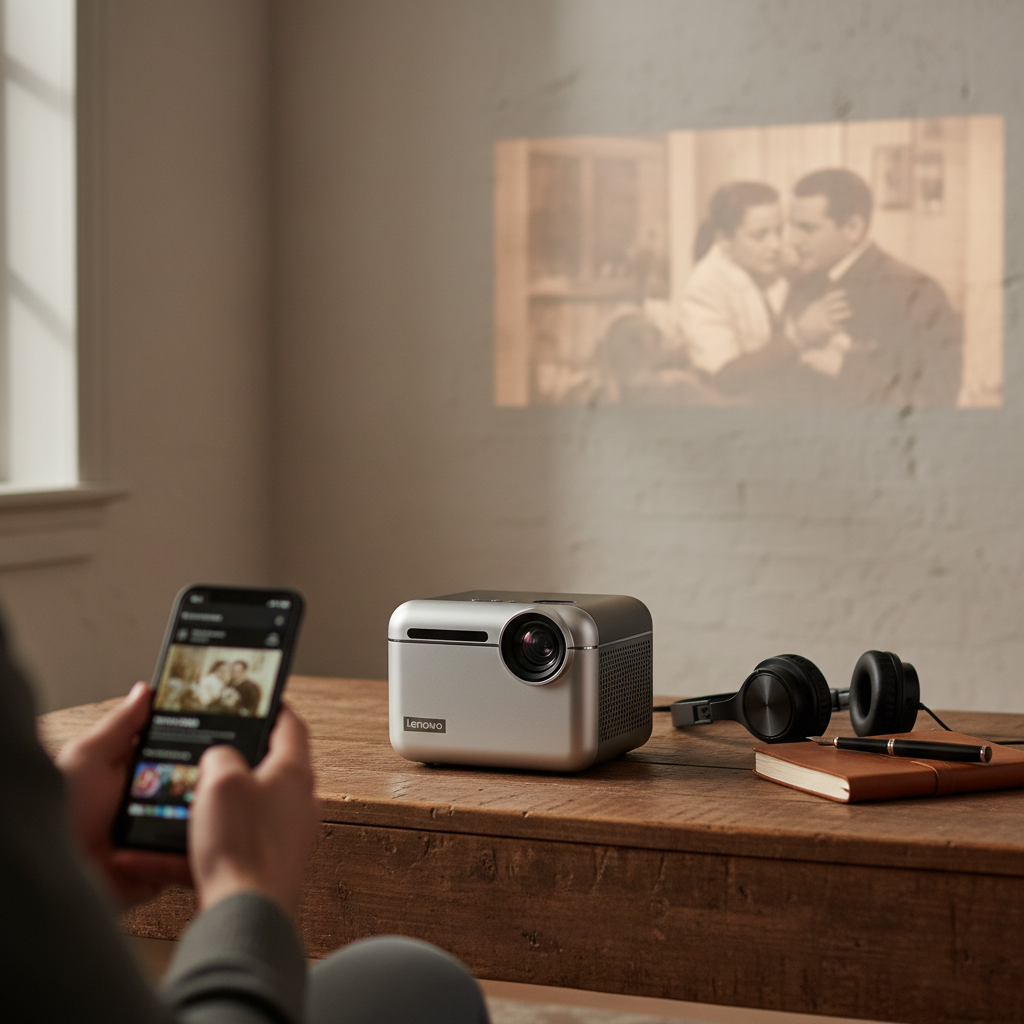
In the rapidly evolving landscape of portable technology, the Lenovo Pocket Projector (P0510) emerges as a fascinating relic, first gracing the market between 2015 and 2016. This device, once a promising contender in the nascent pico projector segment, aimed to bring big-screen entertainment and presentations into the palm of your hand. But how does this “vintage” gadget stack up in an era dominated by high-definition streaming and seamless connectivity? Let’s take a closer look at what the Lenovo Pocket Projector offered then, and whether it holds any charm today.
The Lenovo Pocket Projector: A Look Back
When the Lenovo Pocket Projector first debuted, it stepped into a market eager for truly portable display solutions. It wasn’t designed to replace a full-fledged home theater projector, but rather to serve as an on-the-go companion for quick presentations, casual movie nights, or sharing photos with friends and family. Its appeal lay in its compact size and the promise of wireless projection, a significant convenience for its time.
At its core, the P0510 was built for flexibility, offering a unique feature that set it apart: a swiveling lens. This design choice allowed users to point the projector at almost any angle, including straight up at a ceiling, without needing external stands. This innovative element, coupled with its small stature, made it a genuine “pocket” projector, ready to deploy in various environments.
Design and Portability: A True Pocket Companion
The Lenovo Pocket Projector lives up to its name, boasting a compact and lightweight design that truly fits in the palm of your hand. Measuring approximately 4.1 x 3.9 x 1 inch and weighing a mere 5.9 ounces (about 170g), it was, and largely still is, incredibly portable. The two-toned aesthetic, combining silver-gray with matte black, gave it a sleek appearance for its era.
The standout physical feature is undoubtedly its 90-degree swiveling lens. This manual rotation allowed for immense flexibility in positioning, from a traditional front projection to beaming content onto a ceiling. The device even offered automatic keystone correction, helping to maintain a rectangular image despite the angled projection. This design made it remarkably adaptable for impromptu setups, whether you were in a meeting room, a hotel, or even lying in bed. Its rubber-like material offered a soft touch, though it was noted to attract dust and lint somewhat easily.
Performance Metrics: Understanding a Vintage Picture
Stepping into the realm of image quality, it’s crucial to remember the context of the Lenovo Pocket Projector’s release. It was never intended to compete with larger, brighter, or higher-resolution projectors.
Brightness and Resolution
|
Our Picks for the Best Mini projector in 2026
As an Amazon Associate I earn from qualifying purchases.
|
||
| Num | Product | Action |
|---|---|---|
| 1 | Optoma 4K UHD Projector HDR High Brightness Home Theater DLP Technology White Compact Design Gaming Ready Streaming Bundle HDMI Cable CPS 12 Month Protection Plan Included |

|
| 2 | HAPPRUN Native 1080P Bluetooth Mini Projector, Full HD Portable Outdoor Movie Projector with Built-in Speaker, Compatible with Smartphone, HDMI, USB, AV, Fire Stick, PS5 for Home, Bedroom, Outdoor Use |
|
| 3 | Magcubic Mini Projector with WiFi 6 and Bluetooth 5.4, Portable Projector 4K Support, 5W Soundbase Speaker, Auto Vertical Keystone 180°Rotatable Smart Proyector for Movie Home Outdoor |
|
| 4 | 【Built-in APPS & Electric Focusing & 210° Rotation】Mini Projector With Wifi And Bluetooth, 1080P Portable Projector, Movie Projector for Bedroom, Supports Smartphones/TV Stick/iPad/PS5/Laptop/HDMI/USB |
|
| 5 | Mini Projector with WiFi 6 and Bluetooth 5.4 Built-in Apps for Bedroom Portable Projector Android 14 Smart Auto Keystone 1080P 4K Support Compatible with iOS/HDMI/TV Stick VisualCube 300 White |
|
| 6 | Mini Projector, ELEPHAS Portable Projector for iPhone, 7000L with Synchronize Smartphone Screen, Movie Projector with 1080P HD/200 Screen Support, Compatible with Android/iOS/TV Stick/HDMI/USB/SD |
|
| 7 | Mini Projector with Wifi 6 and Bluetooth5.4, Portable Projector 4K Support, Android 14 Smart Proyector with 200ASIN & Auto Keystone, Alwtniet HY300Pro Small Proyector for Bedroom, Movie, Outdoor |
|
| 8 | HP Smart Mini Projector with WiFi and Bluetooth, Short Throw Projector, Native 1080P Full HD, Official Licensed Apps, Auto Focus & Keystone, Portable Movie Projector for Bedroom & Outdoor |
|
| 9 | CiBest Mini Projector, Upgraded Full HD 1080P Support Video Projector, Portable Small Movie Projector, Compatible with iOS/Android/Windows/TV Stick/Box/USB/HDMI |
|
| 10 | [Built-in Apps] CLOKOWE Mini Projector with WiFi and Bluetooth, 2026 Upgraded 1080P Smart Portable Projector with 180° Rotation, Auto Keystone, Compatible with iPhone/Android/Laptop/TV Stick/HDMI/USB |
|
The projector features a modest 50 ANSI lumens of brightness. While this might seem extremely low by modern standards, for a pico projector of its vintage, it was acceptable for specific use cases. The key caveat: it demands a completely dark room to deliver a watchable image. Any significant ambient light will wash out the picture, rendering it difficult to see.
Its native resolution is 854×480 pixels (480p), projecting with a 1000:1 contrast ratio using DLP technology with a triple LED light source. This meant crisp and vivid colors for its resolution, performing well for videos and images. The LED light source also promised a long lifespan of up to 20,000 hours. The projector could cast an image up to 110 inches diagonally at a distance of about 3 meters, though optimal viewing was often cited closer, around 37 inches at 1 meter or 75 inches at 2 meters. Beyond 3 meters, images and videos tended to blur.
Audio Experience
The Lenovo Pocket Projector includes dual built-in 0.5W speakers. Reviews consistently describe the audio as soft and somewhat “brassy.” While sufficient for a small presentation in a quiet room, they are far from adequate for an immersive movie-watching experience. For better sound, connecting external speakers via the 3.5mm audio jack would be necessary.
Connectivity and Usability: Wireless Focus
One of the defining characteristics of the Lenovo Pocket Projector is its reliance on wireless connectivity, as it notably lacks any wired HDMI or MHL ports. This design choice, while bold for its time, meant a trade-off in universal compatibility and connection reliability.
Wireless Capabilities
The projector supports wireless streaming via Miracast (for Windows 8.1 and later, with Miracast protocol support), DLNA, and Apple’s AirPlay (for Mac and iOS devices). Additionally, it features a microSD card slot that can accommodate cards up to 32GB, allowing users to play media files (MP4, AVI, MPEG, MOV, MP3, JPG, PDF) directly from storage without a connected device.
While wireless connectivity offered convenience, it wasn’t always seamless. Some reviewers reported occasional dropped connections during testing, which could be a nuisance. The initial Wi-Fi setup process was also described as a bit convoluted, requiring users to connect to the projector’s Wi-Fi signal, navigate to an IP address in a browser, and then configure it to connect to their home network. This wasn’t straightforward for everyone.
User Interface and Controls
The projector features a cross-shaped control pad on its top surface, along with a central selection button and a back button. This eliminated the need for a separate remote, keeping the device self-contained and easy to operate directly. The built-in software was generally easy to navigate once connected.
The Verdict: Is the Lenovo Pocket Projector Still Worth It (in 2026)?
Given its origins in the mid-2010s, the Lenovo Pocket Projector undoubtedly falls into the “vintage” category. In 2026, the mini projector market has seen significant advancements in brightness, resolution (often 1080p native, even 4K support), smart features (Android TV built-in), battery life, and most importantly, wired connectivity (HDMI 2.0 is standard).
For the average consumer seeking a portable projector today, the Lenovo Pocket Projector would likely be a disappointment due to its low brightness, 480p resolution, and lack of direct HDMI input. Modern streaming devices, gaming consoles, and even many laptops rely heavily on HDMI for optimal performance. The wireless-only approach, while innovative for its time, now feels restrictive.
However, for a niche audience, this projector might still hold some appeal:
- Nostalgia Collectors: Those who appreciate older tech and want to experience a piece of Lenovo’s history.
- Specific Use Cases: Perhaps for very casual, infrequent use in a perfectly dark room, or for displaying content from older microSD cards.
- DIY Enthusiasts: For those who enjoy tinkering with older gadgets and finding creative ways to integrate them.
“The Lenovo Pocket Projector was a solid entry for its time, prioritizing portability and flexible viewing. While its specifications are modest by today’s standards, its unique swiveling lens remains an impressive design choice for a pico projector.”
If you’re considering this projector today, understand its limitations. It’s not a modern workhorse but a testament to early innovation in portable projection.
Conclusion
The Lenovo Pocket Projector (P0510) represents a significant step in the evolution of mini projectors. Released when portability and wireless convenience were just beginning to gain traction, its swiveling lens, compact design, and battery operation were compelling features. While its 50-lumen brightness and 480p resolution are now far surpassed by contemporary models, and the absence of a wired HDMI port presents a notable hurdle for modern connectivity, it remains a functional device under very specific conditions.
For those looking to relive a piece of tech history, or for a highly niche application in a pitch-dark environment, the Lenovo Pocket Projector can still technically perform. However, if your goal is to enjoy vibrant, high-definition content with seamless connectivity, a modern mini projector would undoubtedly be a more suitable and satisfying choice. Have you ever owned an older piece of tech that you still find charming despite its modern counterparts?
Frequently Asked Questions
What is the native resolution of the Lenovo Pocket Projector?
The Lenovo Pocket Projector (P0510) has a native resolution of 854×480 pixels, commonly referred to as 480p. This resolution is suitable for standard-definition content and casual viewing, but it won’t deliver the sharpness of high-definition projectors popular today.
Does the Lenovo Pocket Projector have an HDMI port?
No, the Lenovo Pocket Projector does not feature an HDMI port. It relies entirely on wireless connectivity through Miracast, DLNA, and AirPlay, or direct media playback via its microSD card slot. This can be a limitation for connecting to many modern devices.
How bright is the Lenovo Pocket Projector?
The Lenovo Pocket Projector offers a brightness of 50 ANSI lumens. This is a relatively low brightness level, meaning the projector performs best in completely dark rooms. In environments with ambient light, the image will appear washed out and difficult to view.
Can I use the Lenovo Pocket Projector with my smartphone?
Yes, you can connect the Lenovo Pocket Projector wirelessly with compatible Android smartphones via Miracast or DLNA, and with iOS devices (iPhones, iPads) via AirPlay. You can also transfer media files to a microSD card and play them directly from the projector.
Is the Lenovo Pocket Projector still a good purchase in 2026?
While the Lenovo Pocket Projector was a capable device for its time (released 2015-2016), its 480p resolution, 50-lumen brightness, and lack of wired HDMI connectivity make it significantly outdated compared to modern mini projectors. For general use in 2026, newer models offer a far superior experience in terms of image quality, brightness, and versatility.