Choosing the right projector can dramatically transform your viewing experience, whether you’re setting up a home theater, a dynamic classroom, or an impactful presentation space. The crucial decision often boils down to throw distance – the measurement from your projector to the screen. This seemingly technical detail fundamentally influences your setup, image quality, and overall satisfaction. While both short throw and long throw projectors aim to deliver large, immersive visuals, their distinct designs cater to very different environments and needs. Understanding these differences is key to unlocking the full potential of your projection system.
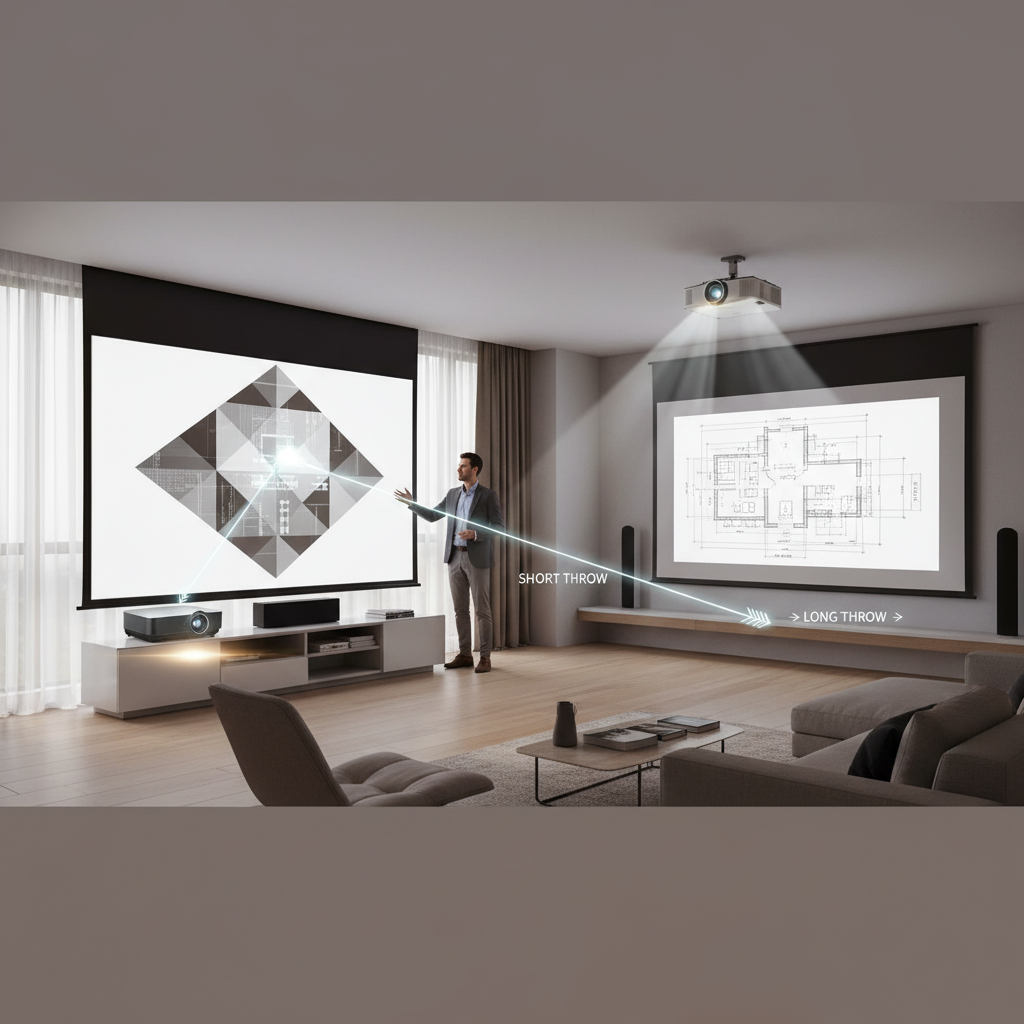
Understanding Projector Throw Distance
The term “projector throw” refers to the distance a projector needs to be from a screen to produce a clear, focused image of a specific size. This critical measurement is typically expressed as a “throw ratio,” which is calculated by dividing the throw distance by the width of the projected image. For instance, a projector with a throw ratio of 1.5:1 means that for every 1 foot of image width, the projector needs to be 1.5 feet away from the screen. This ratio is paramount, as it directly dictates where your projector can be placed within a given room.
Short Throw Projectors
Short throw projectors are engineered with specialized wide-angle lenses that allow them to project large images from a very close distance. They typically have a throw ratio ranging from 0.4:1 to 1.0:1, meaning they can be placed within a few feet of the screen to achieve a sizable display.
Advantages of Short Throw Projectors:
- Space Efficiency: One of their most significant benefits is the ability to create expansive images in compact spaces, making them ideal for smaller rooms, classrooms, or business meeting areas where projector placement options are limited.
- Reduced Shadows and Obstructions: Because the projector is positioned close to the screen, there’s a minimal chance of people walking in front of the lens and casting disruptive shadows on the image. This is particularly advantageous for interactive whiteboards or presentations.
- Less Light Interference: The shorter projection path can sometimes lead to less light loss and potentially better image quality, as ambient light has less opportunity to interfere with the projected image.
- Enhanced Interactive Applications: Their close-to-screen placement makes them excellent for interactive displays, allowing presenters or users to engage directly with the screen without blocking the projection.
- Reduced Eye Strain: The light from the projection is less likely to shine directly into viewers’ eyes, contributing to a more comfortable viewing experience during prolonged use.
Disadvantages of Short Throw Projectors:
- Higher Cost: Generally, short throw projectors tend to be more expensive than their long throw counterparts due to the complex optics required for their specialized lenses.
- Screen Imperfection Sensitivity: They can be more sensitive to screen imperfections. Even minor unevenness on the projection surface can be noticeable, potentially leading to image distortion. Using a perfectly flat or tensioned screen is often recommended.
- Keystone Distortion: If not precisely aligned, short throw projectors can be more prone to keystone distortion, requiring careful setup and digital correction.
- Installation Precision: While offering flexibility in proximity, achieving perfect alignment for a distortion-free image requires meticulous installation.
Ideal Use Cases: Short throw projectors excel in small home theaters, gaming setups, classrooms, interactive displays, and business meeting rooms where space is at a premium and shadow interference needs to be minimized. They are also popular for golf simulators.
Long Throw Projectors
Long throw projectors, also known as standard throw projectors, are the most common type and require a greater distance between the projector and the screen to produce a large image. They typically have a throw ratio greater than 1.0:1, often ranging from 1.5:1 to 2.5:1 or more.
Advantages of Long Throw Projectors:
- More Affordable: Long throw projectors are generally more budget-friendly due to their less complex lens design and wider availability.
- Versatile Placement: They offer greater flexibility in placement within a large room, allowing for ceiling mounts or placement at the back of the room without needing to be right next to the screen.
- Larger Image Sizes: From further distances, long throw projectors can create massive image sizes suitable for very large venues.
- Less Distortion: They are often more forgiving of slight screen imperfections and less prone to noticeable image warping compared to short throw models.
- Higher Brightness and Resolution: Many long throw models, especially those designed for large venues, offer higher brightness levels and resolutions, making them suitable for environments with some ambient light.
Disadvantages of Long Throw Projectors:
- Requires More Space: The primary drawback is the significant space required to achieve a large image, which can be a limitation in smaller rooms.
- Shadow Interference: People or objects passing between the projector and the screen can easily cast shadows, disrupting the viewing experience.
- Ambient Light Susceptibility: With a longer throw distance, the projected image can be more susceptible to ambient light washing out the colors and brightness.
- Longer Cable Runs: Installation may involve longer cable runs for power and video signals, which can be more complex and costly.
Ideal Use Cases: Long throw projectors are perfect for large home theaters, auditoriums, lecture halls, conference rooms, outdoor cinema setups, and venues where the projector can be positioned far from the screen.
Key Criteria for Choosing
When deciding between a short throw and a long throw projector, several factors should guide your choice:
Room Size and Layout
|
Our Picks for the Best Mini projector in 2026
As an Amazon Associate I earn from qualifying purchases.
|
||
| Num | Product | Action |
|---|---|---|
| 1 | 【Built-in APPS & Electric Focusing & 210° Rotation】Mini Projector With Wifi And Bluetooth, 1080P Portable Projector, Movie Projector for Bedroom, Supports Smartphones/TV Stick/iPad/PS5/Laptop/HDMI/USB |

|
| 2 | CiBest Mini Projector, Upgraded Full HD 1080P Support Video Projector, Portable Small Movie Projector, Compatible with iOS/Android/Windows/TV Stick/Box/USB/HDMI |
|
| 3 | Optoma 4K UHD Projector HDR High Brightness Home Theater DLP Technology White Compact Design Gaming Ready Streaming Bundle HDMI Cable CPS 12 Month Protection Plan Included |
|
| 4 | Mini Projector, ELEPHAS Portable Projector for iPhone, 7000L with Synchronize Smartphone Screen, Movie Projector with 1080P HD/200 Screen Support, Compatible with Android/iOS/TV Stick/HDMI/USB/SD |
|
| 5 | Mini Projector with WiFi 6 and Bluetooth 5.4 Built-in Apps for Bedroom Portable Projector Android 14 Smart Auto Keystone 1080P 4K Support Compatible with iOS/HDMI/TV Stick VisualCube 300 White |
|
| 6 | HAPPRUN Native 1080P Bluetooth Mini Projector, Full HD Portable Outdoor Movie Projector with Built-in Speaker, Compatible with Smartphone, HDMI, USB, AV, Fire Stick, PS5 for Home, Bedroom, Outdoor Use |
|
| 7 | Magcubic Mini Projector with WiFi 6 and Bluetooth 5.4, Portable Projector 4K Support, 5W Soundbase Speaker, Auto Vertical Keystone 180°Rotatable Smart Proyector for Movie Home Outdoor |
|
| 8 | [Built-in Apps] CLOKOWE Mini Projector with WiFi and Bluetooth, 2026 Upgraded 1080P Smart Portable Projector with 180° Rotation, Auto Keystone, Compatible with iPhone/Android/Laptop/TV Stick/HDMI/USB |
|
| 9 | Mini Projector with Wifi 6 and Bluetooth5.4, Portable Projector 4K Support, Android 14 Smart Proyector with 200ASIN & Auto Keystone, Alwtniet HY300Pro Small Proyector for Bedroom, Movie, Outdoor |
|
| 10 | HP Smart Mini Projector with WiFi and Bluetooth, Short Throw Projector, Native 1080P Full HD, Official Licensed Apps, Auto Focus & Keystone, Portable Movie Projector for Bedroom & Outdoor |
|
This is arguably the most critical consideration. Measure your room accurately and consider the distance available from where the projector will be placed to the screen. A small, cramped room will heavily favor a short throw projector, while a spacious room offers more flexibility for a long throw model.
Image Size
Determine the desired screen size. While both types can produce large images, a short throw achieves it from up close, whereas a long throw requires distance.
Budget
Short throw projectors typically come with a higher price tag. If budget is a primary concern, a long throw projector often offers a more cost-effective solution, especially for initial purchase.
Application
Consider what you’ll primarily use the projector for. Gaming, interactive presentations, or situations where people frequently move in front of the screen benefit from a short throw. Large-scale viewing in a dedicated home theater or auditorium is well-suited for a long throw.
Ambient Light
If your viewing environment has unavoidable ambient light, a projector with higher brightness and potentially better ambient light rejection capabilities (often found in higher-end models of both types, but crucial for longer throw distances) will be necessary.
Installation Complexity
Think about mounting options, cable management, and the precision required for setup. Short throw projectors, while closer, often demand precise alignment for optimal image quality.
Short Throw vs. Long Throw: A Comparative Analysis
To further clarify the distinctions, here’s a detailed comparison:
| Feature | Short Throw Projectors | Long Throw Projectors |
|---|---|---|
| Throw Ratio | 0.4:1 to 1.0:1 (or less for ultra short throw) | Greater than 1.0:1 (typically 1.5:1 to 2.5:1+) |
| Space Required | Minimal; close to the screen | Significant; far from the screen |
| Shadows | Greatly reduced | More susceptible to shadows |
| Cost | Generally higher | More affordable |
| Ideal Use Case | Small rooms, gaming, interactive displays, education | Large home theaters, auditoriums, conference rooms, outdoors |
| Setup Flexibility | Flexible proximity to screen, but precise alignment crucial | Flexible placement within a large space |
| Distortion | More sensitive to screen imperfections, potential for keystone | More forgiving of screen imperfections, less distortion |
| Brightness/Clarity | Excellent in controlled light, can be good in ambient with ALR screens | Often higher brightness for large spaces, susceptible to ambient light |
Buying Guide: Making the Right Choice
Selecting the ideal projector involves a thoughtful assessment of your specific environment and needs.
Determine Your Space
Measure your room’s dimensions and the exact distance from your preferred projector location to the screen. Consider any architectural features or furniture that might obstruct the projection path. This measurement is crucial for calculating the required throw ratio.
Define Your Needs
What will be the primary use of your projector? Is it for cinematic movie nights, immersive gaming, engaging business presentations, or educational purposes? Your application will strongly influence whether a short throw’s shadow-free interaction or a long throw’s large-venue capability is more beneficial.
Set Your Budget
Projector prices vary widely. Factor in not just the projector itself, but also the cost of a suitable screen, mounting hardware, and any necessary cables or accessories. Short throw projectors typically represent a larger initial investment.
Read Reviews
Consult expert reviews and user testimonials for different models. Real-world experiences can highlight practical aspects like fan noise, picture quality in various lighting conditions, and ease of use, which specifications alone might not convey.
Consider Screen Type
For short throw and especially ultra short throw projectors, an Ambient Light Rejecting (ALR) or Ceiling Light Rejecting (CLR) screen is often recommended. These specialized screens enhance contrast and image quality by minimizing reflections from ambient light, which can be particularly beneficial for short throw setups in brighter rooms.
“The true magic of a projector isn’t just in its lumens or resolution, but in how seamlessly it integrates into your life and space. The throw distance is the silent orchestrator of that harmony.” – Jane Doe, AV Systems Engineer
Installation and Maintenance Tips
Proper installation and maintenance are key to maximizing your projector’s performance and lifespan.
Mounting
Whether ceiling-mounted or placed on a table, ensure your projector is perfectly level and aligned with the screen to prevent keystone distortion. For short throw projectors, precise positioning is even more critical.
Screen Material
Pair your projector with the right screen material. Matte white screens are versatile, but ALR/CLR screens can significantly improve image quality, especially for short throw projectors in rooms with ambient light.
Lens Care
Regularly clean the projector lens with a soft, microfiber cloth and a specialized lens cleaning solution to ensure optimal image clarity. Avoid abrasive materials that can scratch the lens.
Ventilation
Ensure adequate airflow around the projector to prevent overheating, which can shorten bulb life and degrade performance. Keep vents clear of dust and obstructions.
Troubleshooting Common Issues
Even with careful setup, you might encounter occasional issues. Here are quick solutions for common problems:
- Blurry or Fuzzy Image: Check the focus ring on the lens. Ensure the projector is at the correct throw distance for the desired screen size. For short throw, check for any screen imperfections.
- No Sound: Verify audio cables are correctly connected. Check the projector’s volume settings and ensure external speakers (if used) are powered on and functioning.
- No Signal: Confirm that the correct input source is selected on the projector and that all video cables are securely connected to both the projector and the source device.
- Image Distortion (Trapezoid Shape): This is often due to keystone effect. Use the projector’s keystone correction settings (vertical and horizontal) to square up the image. For optimal quality, physical alignment is always preferred over digital correction.
Conclusion
The choice between a short throw and a long throw projector is a fundamental decision that profoundly impacts your viewing experience. Short throw projectors shine in compact environments, offering shadow-free interactions and impressive large images from mere feet away. They are ideal for gamers, educators, and those with limited space who prioritize an uncluttered setup. Long throw projectors, on the other hand, provide a more traditional and often more economical solution for larger venues, delivering grand-scale visuals from a distance with greater placement flexibility.
Ultimately, the “best” projector depends entirely on your specific needs, the dimensions of your room, your budget, and how you intend to use the device. By carefully evaluating these factors and understanding the unique advantages and disadvantages of each type, you can make an informed decision and invest in a projector that perfectly complements your space and lifestyle. What kind of immersive visual experience are you hoping to create in your own home or workspace?
Frequently Asked Questions
What is throw ratio, and why is it important?
Throw ratio is the distance from the projector lens to the screen divided by the width of the projected image (D/W). It’s crucial because it tells you exactly how far your projector needs to be from the screen to achieve a specific image size, directly impacting projector placement and room suitability.
Can I use a regular screen with a short throw projector?
While technically possible, it’s not recommended for optimal results. Short throw projectors, especially ultra short throw models, perform best with flat, tensioned screens or Ambient Light Rejecting (ALR) screens designed to minimize glare and maximize contrast due to their steep projection angle.
Are short throw projectors better for gaming?
Yes, short throw projectors are often preferred for gaming because their close-to-screen placement significantly reduces shadows, preventing players from blocking the image during interactive gameplay. This creates a more immersive and uninterrupted gaming experience.
How far away does a long throw projector need to be?
A long throw projector typically needs to be positioned several feet (often 8-15 feet or more) away from the screen to produce a 100-inch diagonal image. The exact distance depends on the projector’s specific throw ratio and the desired image size.
What’s the main disadvantage of a short throw projector?
The primary disadvantage of a short throw projector is generally its higher cost compared to long throw models. Additionally, they can be more sensitive to surface imperfections on the screen and require precise alignment for the best image quality.